






What are the risks of using free text editors in business environments?
The main risks at a glance
Inconsistent or delayed security updates
No guaranteed support or response
Reliance on unverified plugins and extensions
Difficulty meeting compliance and audit requirements
Why are free tools harder to use in regulated environments?
In regulated industries, tools must meet more than functional requirements.
They need to support:
- Internal security policies
- Audit and documentation requirements
- Traceability and control
Free tools can still be used, but they often lack:
- Documented security processes
- Predictable update cycles
- Guarantees required for audits
This makes them harder to justify in environments where compliance matters.
Why do plugin dependencies increase risk?
Many free editors rely on plugins for essential functionality.
This creates a layered setup:
- Multiple third-party dependencies
- Varying levels of maintenance
- Unclear security across components
Every plugin adds another layer of risk, especially when its update cycle and security practices are outside your control.
Over time, this makes the environment harder to manage and less predictable.
Why do environments become inconsistent across teams?
Free tools are often configured individually rather than centrally.
This leads to:
- Different setups across team members
- Inconsistent plugin usage
- Uneven update states
Over time, this creates friction:
- Harder collaboration
- Unpredictable behavior
- More effort in onboarding and maintenance
Flexibility at the individual level often results in fragmentation at the team level.
Why these risks increase over time
These issues rarely cause immediate problems.
They build gradually:
- More dependencies
- More users
- More reliance on the tool
As this grows, the impact increases:
- Slower response to issues
- Higher operational uncertainty
- More difficulty meeting compliance requirements
At this point, the tool is no longer just a utility. It becomes part of the organization’s risk surface.
What happens when there is no ownership or support?
Free tools typically do not have formal ownership.
This means:
- No guaranteed support channels
- No defined responsibility for incidents
- No clear escalation path
If something breaks, teams rely on internal effort or community forums. That can slow down resolution, especially in time-critical situations.
In business environments, the issue is not just whether something breaks, but how quickly it can be fixed.
Why do teams use free text editors in the first place?
Free editors are easy to adopt.
They are:
- Quick to install
- Flexible through plugins
- Familiar to most developers and analysts
- Free from procurement or approval processes
For individual use or low-risk tasks, this works well. Problems start when these tools are used in environments that require consistency, reliability, and control.
Why do security updates become a risk?
Free tools do not guarantee how quickly vulnerabilities are identified and fixed.
In practice:
- There is no defined timeline for patches
- Updates may depend on community contributions
- Teams must monitor and apply updates themselves
A vulnerability might be fixed quickly, or it might remain exposed longer than expected. In environments handling sensitive data, that uncertainty becomes a risk.
What do organizations use instead?
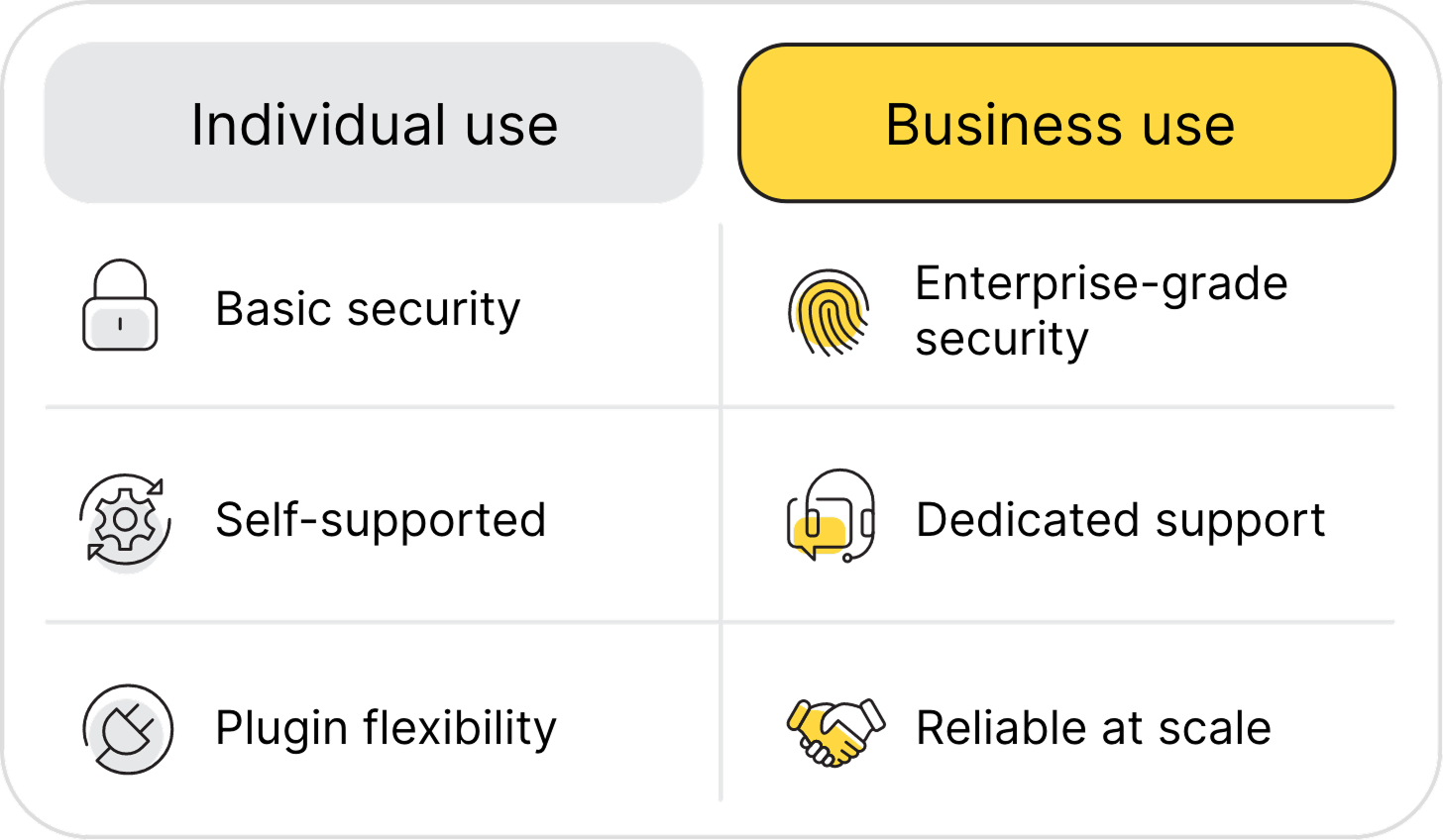
When tools are used in business-critical or regulated environments, the focus shifts to reliability and control.
Teams typically look for:
-
Predictable security practices
Clear processes for identifying and fixing vulnerabilities.
-
Defined support and response
Access to support and clear escalation paths.
-
Consistent environments
Standardized setups across teams.
-
Long-term reliability
Confidence that the tool will continue to be maintained.
This makes it more suitable for higher-risk workflows.
Want to evaluate this in your environment?
→ Try UltraEdit in your workflow
→ Check how it fits your security requirements

Frequently asked questions
Are free text editors unsafe for business use?
What are the biggest risks?
Why does support matter for a text editor?
Do companies restrict free tools?