








Imagine that you are looking at a cryptic NullPointerException at 2 am. Your initial reaction a few years ago was to initiate a Google search, which brought you a 10-year-old Stack Overflow thread. In recent times, you are likely to copy the stack trace into a chat box.
Another viral Reddit post made fun of the fact that Stack Overflow is turning into a ghost town. Although some of the claims about the activity collapsing overnight are exaggerated, the behavioral change is actual. The developers are evidently altering their habits.
This post will discuss the reason why traditional forums are being disrupted by using LLMs for coding. At the end, we will come up with the decision of whether community knowledge is really dying or is it just evolving?
TL;DR:
- The popularity of Stack Overflow is dropping as developers turn to LLMs for coding to get immediate solutions.
- The process of learning is becoming more interactive.
- AI accelerates feature discovery in software and debugging.
- LLMs have such risks as hallucinations and overreliance.
- The most skilled developers are those who incorporate AI with human checks.
Is Stack Overflow Really “Dying”?
The answer to this is no, but it is certainly becoming thin. There is a tendency of a new downward trend in Stack Overflow regarding new questions and day-to-day activity. However, it is too dramatic to die on a platform that contains decades of programming history.
Friction greatly affects this change. There is also a lot of reputation anxiety and fear of duplicate closures on Stack Overflow. LLMs for coding eliminate this pressure and deliver judgment-free responses.
You do not have to wait until a human being responds to you, but rather, you instantly have a synthesis. The pace is strong and convenient. This is not a crash; it is a move towards a private AI assistance.
The Rise of LLMs as Learning Tools
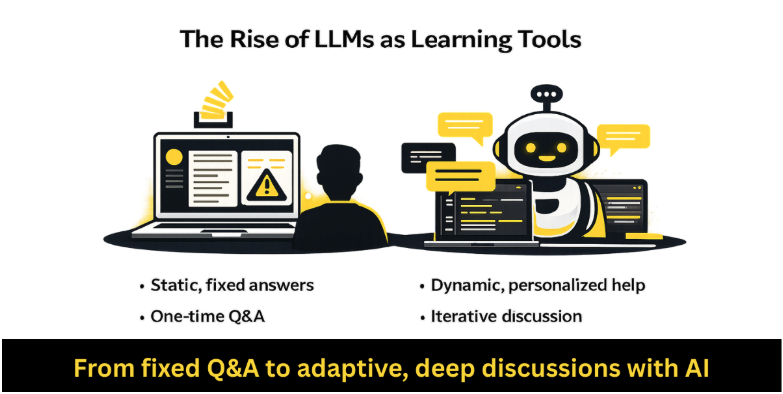
Conventional Q&A forums are fixed. You locate a post, read it, and wish that it were the same as your version in the library. ChatGPT for programming transformed this through dynamic and context-sensitive interactions.
You are able to enter your code and get a customized explanation. You are able to refine your prompt until you have something that makes sense. Such a loop forms an individual learning experience.
The comparison between the experiences is as follows:
| Feature | Stack Overflow | LLMs for Coding |
| Response Speed | Minutes to Days | Instant |
| Context | Static and General | Deeply Personalized |
| Interaction | One-off Q&A | Iterative Conversation |
| Feedback | Community Voting | Probabilistic Generation |
With AI coding tools, developers are now able to discuss and are not simply searching. It is possible to inquire why a certain pattern was selected. That is what it feels like to have a patient mentor by you and learn to code with AI.
Relearning How To Learn
This is a cognitive change in the education of developers. We optimize prompts instead of thread browsing. Learning tools used by the developers are now interaction-based and not archival-based.
There are actual benefits to this change. It is also associated with severe risks. All engineers are expected to know both.
The Pros
- Faster Onboarding: LLMs for coding allow you to learn new syntax faster when you are coding.
- Reduced Intimidation: Juniors will feel freer to pose beginner questions during a private session.
- Contextual Explanations: AI can analyze your code rather than providing generic snippets.
The Risks
- Hallucinations: AI can provide tools or APIs that are not real.
- Loss of Critical Thinking: Blind copy-pasting weakens long-term understanding.
- The Filter Bubble: You will fail to see a variety of architectural opinions that exist in forum discussions.
Discipline is required when using AI-assisted programming. Output has to be checked against documentation. Always, never outsource your thinking.
Feature Discovery In The Age Of AI
Feature discovery in software has never been easy. Programs such as UltraEdit are loaded with thousands of options in menus. In the past, users depended on developer learning tools and forums that were community-based.
At this point, the workflow appears different. Users do not have to scan manuals, but instead pose direct questions to the LLMs for coding. The AI displays relative documentation immediately.
This significantly enhances the learning of developer productivity tools. It reduces the obstacle of learning complicated programs. Simultaneously, it makes companies keep proper, systematic records.
UltraEdit’s Community-Driven Legacy
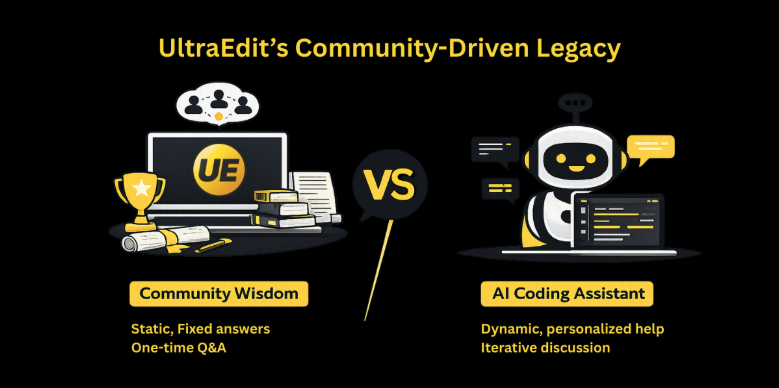
UltraEdit has been there for decades. As time went on, it developed a rich ecosystem of macros, Word files, and forum conversations. This constitutes the power of community-driven developer tools.
LLMs for coding are able to extract knowledge in a short period. However, they rely on the depth of existing material. The support groups of UltraEdit offer experience gained through battles, which AI cannot create.
At the same time, UltraEdit is evolving alongside these changes. With integrations like the Pieces plugin, users can now access AI-powered assistance directly within the editor, asking questions about their code or text without switching tools. This brings the speed and convenience of LLMs into the workflow while still complementing UltraEdit’s strong foundation of community-driven knowledge.
AI, including LLMs for coding, is not an alternative to years of experience. It simply reallocates access to that experience. The community still forms the foundation that makes information reliable.
AI assistants Vs. Community help: Replacement or Reinforcement?
Is it really AI vs Stack Overflow? The future is hybrid and not competitive. LLMs for coding are also trained on data released by the community.
When communities cease to contribute, the quality of AI will eventually decrease. Models have the risk of reusing erroneous content. Fresh human input is still necessary.
This way, we are heading towards a mixed workflow:
- Quick syntax and boilerplate AI assistants.
- The ultimate source of truth is in official documentation.
- Community forums on subtle architectural discussions and edge cases.
The Stack Overflow decline could simply be a reduction in noise. Simple questions are now handled by LLMs for coding. More complex human issues still stay on forums.
Conclusion
Stack Overflow is not going to disappear. It is evolving to become a professional database of the history of programming. The activity of developers is moving to conversational AI-driven workflows.
LLMs for coding provide efficiency and customization. But speed without checking makes weak systems. Strong engineers are still characterized by critical thinking.
The future belongs to hybrid learners. They use LLMs for coding to discover solutions faster. They rely on documentation and community insight to establish the truth.
FAQs
Are LLMs For Coding Better Than Stack Overflow?
They are quicker and very personalized. However, they lack a voting system and peer review. Reliability is also improved through community validation.
Will AI-Assisted Programming Replace Junior Developers?
No, it will redefine their roles. Juniors should be good reviewers and prompt engineers. Architectural thinking is still necessary, as well as debugging.
Is Learning To Code With AI Safe For Beginners?
It assists in learning concepts in a short time. But a beginner should not be blindly dependent. Basic debugging and logic skills are still relevant.



0 Comments