








In a world where artificial intelligence is being pushed heavily as the panacea for all technological challenges, UltraEdit dares to ask: Is AI truly as useful as it’s being marketed, or are we opening Pandora’s box by adding it to our ecosystem?
UltraEdit (UE) is a text editor renowned for going the extra mile when it comes to text editor security. And for some, adding AI might be seen as a step in the opposite direction—it’s adding vulnerability and possible breach points. And while that is technically true, it doesn’t paint the complete picture. As with new technologies breaking into public use, it can invite skepticism and get disproportionately villainized.
We’ve decided to add AI to UE because we believe the benefits far outweigh the risks and because we believe that AI is not as dangerous as it seems. And there are many steps and precautions that we have implemented to mitigate the risks associated with it.
Read on further to learn more about the factors that influenced us and what were the key principles that guided the decision to add AI to UE.
How we see AI Today
At this point, everyone has heard about it. AI this, AI that. It’s come to a point where it is more unbelievable if you haven’t heard or even tried it at all. In fact, the top tech companies show no signs of slowing down and are projected to invest $300 billion in 2025 as the AI arms race continues.
AI (or generative AI) in this case has fueled one of the largest disruptions across various industries and markets, impacting job markets, business models, and even regulatory landscapes. It forced businesses to rethink and reimagine how they can retool their business to utilize this hot new technology.
As a commercially supported software, UltraEdit wasn’t safe from answering the question: Is there benefit in adding AI in our text editor?
Historically, UltraEdit’s was and is a user-guided application. Even in its early days, most of what was added was the result of suggestions or requests from users who had very specific problems.
At this point, we don’t see generative AI technology that much different from other requests from our users. If it’s something that can solve the problems that our users may have, it will always be a consideration.
Why UltraEdit decided to add AI
I had a sit-down chat with Bradley Hawkins, our product development manager at UE, to discuss what were the reasons, considerations, and possible repercussions of adding generative AI features to UE.
Reason 1: We don’t consider Generative Artificial Intelligence to be intelligent.
Generative AI is a response-driven AI that uses a series of complex mathematical models and algorithms that can take a huge superset of data and use them to create logically sounding responses.
It’s highly useful if you want an almost instantaneous response based on your own thoughts. Our brains are generally better at stimulated from the interaction. Bouncing ideas back and forth makes us more productive.
It sounds like we’re getting actual feedback from generative AI, but in actuality, it’s just taking prompts from us—the bonafide thinking entity. It mimics intellect but is not intelligent itself.
“I don’t actually consider it to be artificial intelligence. Because there’s no actual intelligence, artificial or otherwise.” shares Brad.
He believes that there is a certain level of human association and human communication present in generative AI. And because of that, he’s fine with people calling it artificial intelligence because it manifests a key sign of intelligence—language.
Currently, generative AI is most useful for language applications because there is a lot of aggregate text data available freely on the internet that it can use for associating datapoints. As the name suggests, a humongous amount of data is essential for these large language models (LLMs) to work. (It’s also why it can be useful for UltraEdit users working on large data sets.)
In its current iteration, generative AI requires a stimulus—a prompt for which it can start its algorithms. It cannot create anything without getting context from humans.
“A general AI should be able to respond, essentially unprompted or with minimal stimulus. Generative AI can do nothing at all without specific stimuli, or a conversation partner.” explains Brad.
The bottomline is it’s not as intelligent as it’s hyped up to be, and thus not as dangerous. Generative AI will never go haywire like the AI in The Matrix would suggest, and in the same way it is unlikely to expose your data proactively and without the user’s help (spoiler alert).
Reason 2: It’s an amazing piece of technology that can benefit a lot of our users.
Another big impetus for adding AI is simply because it provides a benefit to UE’s users. A lesser known fact about UltraEdit is that most, if not all, of the features you see in it today was a product of user needs or requests.
And we’re not just saying that because we have a vested interest in promoting the usage of AI. One reason for the marketing madness is because some businesses invested millions of dollars into LLM development. They need people to use it to succeed. We don’t have as much stake into it, so we’re a bit comfortable with downplaying it a bit.
But regardless of how it’s marketed, we cannot deny that it’s super useful for some of our users. Generative AI may not be as intelligent as some companies would claim, but even on the surface, we cannot deny how handy it is for a lot of UltraEdit’s use cases.
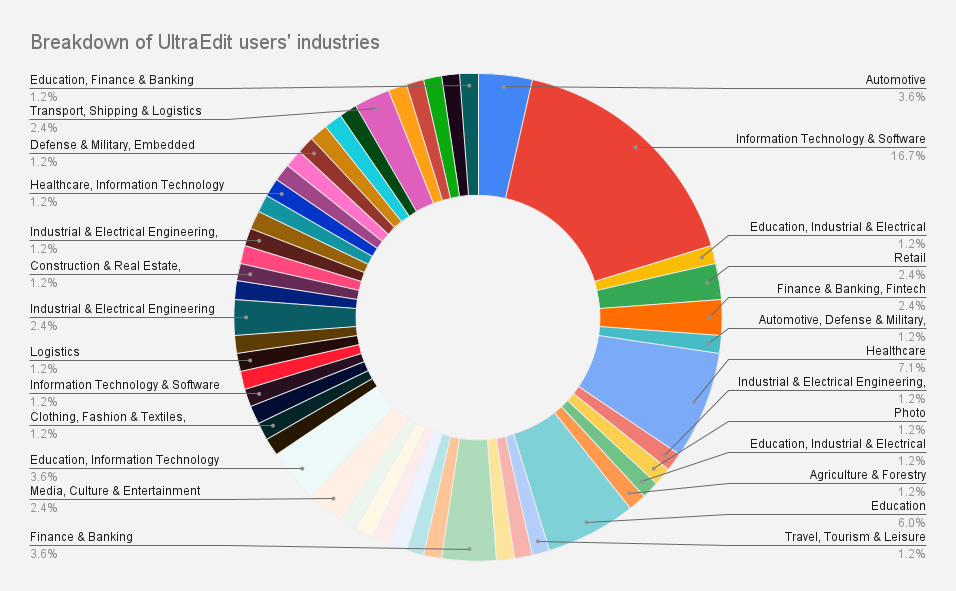
UltraEdit users’ industry survey results (2022 user survey)
For instance, with large datasets or large swaths of text, having the power of Generative AI and LLMs to parse and summarize them for our users saves a lot of time. Especially with the integrated AI window inside UltraEdit, this creates a seamless experience wherein users can select and paste relevant text in one fell swoop.
So in summary, it doesn’t take much for our developers to consider a solution as long as there is a real and tangible problem that it solves for our users. And in the case of generative AI, there were too many potentially useful things for a wide variety of our users and we couldn’t let the opportunity slip.
Reason 3: The dangers in using AI is almost the same as the dangers of using any other tool.
We’ve established how useful (or potentially useful) AI can be. But that’s not to say that it’s completely without its downsides. As a security-minded software, we acknowledge that anything that increases surface area can also increase risk for security breaches, inadvertent or otherwise.
Using Large Language Models in software is both exciting and a bit risky. These models can do amazing things with data, but they also open up new ways for security issues to sneak in. It’s important to note, however, that the biggest factor is the user.
LLMs are completely dependent on stimuli given by a user. In connection with our stance on how generative AI is still an incomplete intelligence, the majority of the risk involved in using LLMs is (1) what prompts the user provides, (2) how the AI’s responses are used, and (3) where the response data/information is used.
For example, users should never provide sensitive company or client data when prompting generative AIs. Companies disallow the use of AI because the prompts themselves can be recorded and added to the training dataset of LLMs—the stimuli from users can be used as input data for training the LLM.
Likewise, users should never insert code from an LLM without double checking yourself. Similar to getting an email from a stranger, you don’t use the information no matter how innocuous it may seem.
“You could easily take one thousand lines of code from an AI chatbot, shove it into your application and all of a sudden you’ve opened a back door to hackers everywhere.” adds Brad.
But hey, it’s not just LLMs that have these issues. Using other tools like email, social media platforms, and even third-party plugins also come with a similar set of risks.
Anytime you’re working with something outside the confines of your local system—and that applies to using the UE SSH terminal, to using SFTP, and even something as simple as local network sharing. But as soon as you engage with something beyond local network share, you automatically open yourself and increase your attack surface.
And Brad adds that at the very least, generative AI is predictable in its responses. “It may not [give] what I want, but I always get what I expect.” So, while LLMs add some complexity, with a similarly trained (or untrained) user, they’re not more dangerous than other tools we use every day.
What we’re doing to mitigate risks of AI
One of the major factors that helped in deciding to add AI to UltraEdit is because we were able to enforce precautionary steps These were safeguards that Brad and the team have considered prior to making the decision of adding AI to UE. Their existence rationalizes and enforces our confidence about adding AI to UltraEdit.
Reason 4: It’s optional.
The foremost reason why Brad was confident about adding AI to the text editor was because they set it up with the expectation that it was not going to be mandatory. If for whatever reason a user was not allowed or does not want to touch anything AI with a 10-foot stick, they can.
When you first get a version of UE that has the AI integration using Pieces, you will get an installation prompt. And if a user doesn’t want to install it, they simply have to uncheck the install option. And that’s it. They can use UE as if it never had AI integration.
Furthermore, the AI capabilities in UE will come in the form of an optional plugin. “And to my knowledge and my planning, that’s not going to change anytime soon.” reassures Brad. “Until somebody comes along and overrides me or replaces me, UE will always be available as an AI free application.”
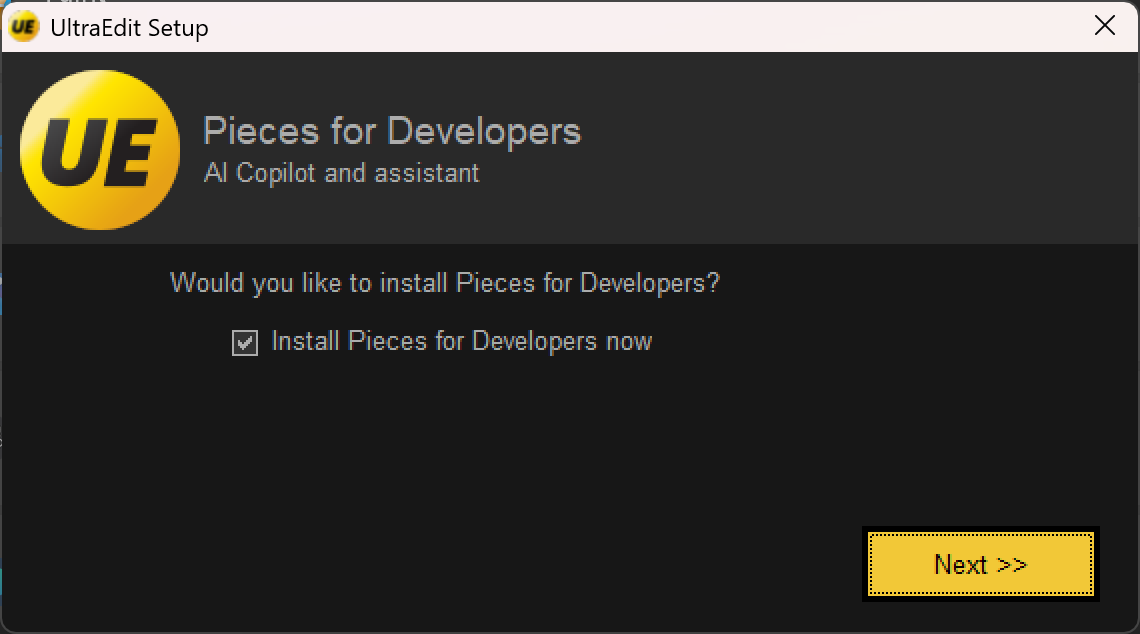
During installation, users have the option of installing (or not installing) the Pieces plugin which adds an AI copilot in UltraEdit.
Reason 5: It uses layers of integration vetted by experts.
One other advantage of the installation setup is that it uses Pieces which acts as an intermediary between UE and the LLMs such as GPT, Gemini, LLama, etc.
Brad himself admits that he knows the basics of AI but does not claim to be an expert in the matter. That is why employing Pieces was a very conscious thought. “We did not give users access to a direct connection to an AI service. We gave users access to a third party.” said Brad.
Contrary to a direct integration wherein other editors and IDEs integrate the AI services like an API, Pieces is an all-in-one conduit that with just a single install, you get access to multiple AI/LLM services.
“A lot of times developers don’t like gatekeepers.” But in this case, Pieces, as the experts, act as the gatekeeper for these services and provide an extra layer of vetting for the AI services for our users.
Note: There’s no actual security profile attached to this. But in acting as a gatekeeper, the developers of Pieces do have to work with these AI services and they selectively go through the AI services available and try to find the best ones—giving UE users the benefit of a highly curated options list.
Reason 6: UE’s AI services can be run locally.
Another added benefit of using Pieces inside UE is that they provide an option of running these AI services off the cloud (i.e. locally). This cuts off your device from sending (or receiving) data from the AI service providers, minimizing the so-called surface area.
Your sensitive data doesn’t have to take a risky trip over the internet to some far-off server. This lowers the chances of it getting intercepted or accessed by someone who shouldn’t have it. And there’s a bonus: you don’t need to worry about having an internet connection. Local AI works just fine without it, so even if you’re off the grid, you can still have generative AI to supplement your text editing.
And when you have the option, running AI models locally on your own machine might just be the smarter choice when it comes to keeping your data safe and sound.
Things to consider moving forward
There are many other elements that we did not have the opportunity to touch upon in this piece such as the ethics around the massive data gathering LLMs require, or the implications it may have on certain labor markets.
We focused mainly on the potential benefit (and threats) generative AI provides and what guided our decision making process. At the end of the day, we leave it to our users if they want to install the Pieces plugin and utilize AI inside UltraEdit—but that’s not to say this will be our permanent stance.
Things can always change and that’s not something we resist but we also know when we need to take a step back. In any case, we will keep our eyes and ears open for any feedback on ways to improve UltraEdit.
Conclusion
Our decision to incorporate AI was driven by the enthusiastic requests from our users and the immense potential benefits AI can offer, despite the inherent risks. Brad and the team understand that AI introduces new security challenges, but we believe that with the right safeguards and precautions, we can mitigate the risk to a point that it is no bigger than what most of us are already accustomed to.
UE’s AI integration is designed to be lite and optional plugins. This is to allow users to decide how much to utilize. This flexibility helps mitigate potential risks while empowering users to harness the power of AI at their discretion. Insights from Bradley Hawkins, our Product Development Manager, highlight AI as a powerful tool rather than true intelligence.
At UltraEdit, we are committed to ensuring our text editor remains secure. Our features are developed in-house to safeguard our users, and in circumstances we can’t, we will go the extra mile to provide as much leeway for our users.
Striking a balance between convenience, security, and realizing the benefits of the latest technologies is something we strive to achieve—and that of course requires listening to our users! So send me or Brad your feedback. We would very much like to hear it.
Thanks and happy editing!




0 Comments