








A hex editor lets you view and change a file’s raw bytes in hexadecimal instead of relying on an application that may not open it, may reject corrupted data, or may not let you touch it at all. That makes it the standard tool for repairing damaged files, inspecting executables and firmware, and recovering data other editors can’t reach. UltraEdit includes a full hex editing mode built into the same editor used for large text and log files.
What is a Hex Editor?
A hex editor is software for viewing and editing a file’s contents in hexadecimal (base-16) format instead of through the application that normally opens it. Every file, whether it’s an executable, a system file, an image, or a corrupted document, is ultimately a sequence of bytes. A hex editor shows you those bytes directly and lets you change them one at a time.
This matters because most applications only show you an interpreted version of a file. If that interpretation breaks — because the file is corrupted, partially written, or in a format your software doesn’t fully support — a hex editor is often the only way to look at what’s actually there and fix it.
Editing raw bytes carries real risk: change the wrong value and you can corrupt the file further. That’s why a usable hex editor needs to show you exactly where you are in the file (offset), what the raw value is (hex), and what it represents in readable form (character/ASCII) — all at once, side by side.
Why would you need to edit a file in hex?
- Fixing corrupted files. If specific bytes are damaged, you can identify and correct the incorrect values directly, without needing the original source or a full rebuild.
- Inspecting and modifying binary files. Executables, firmware images, and other binary formats can be altered at the byte level without recompiling from source.
- Working with legacy or non-standard encodings. Some systems still exchange data in encodings like EBCDIC rather than ASCII/UTF-8, which a text editor won’t render correctly but a hex editor can display and edit directly.
- Recovering or examining data other tools reject. When a file is too damaged, too unusual, or too low-level for a normal application to open, hex editing is often the fallback.
How do you use a hex editor, step by step?
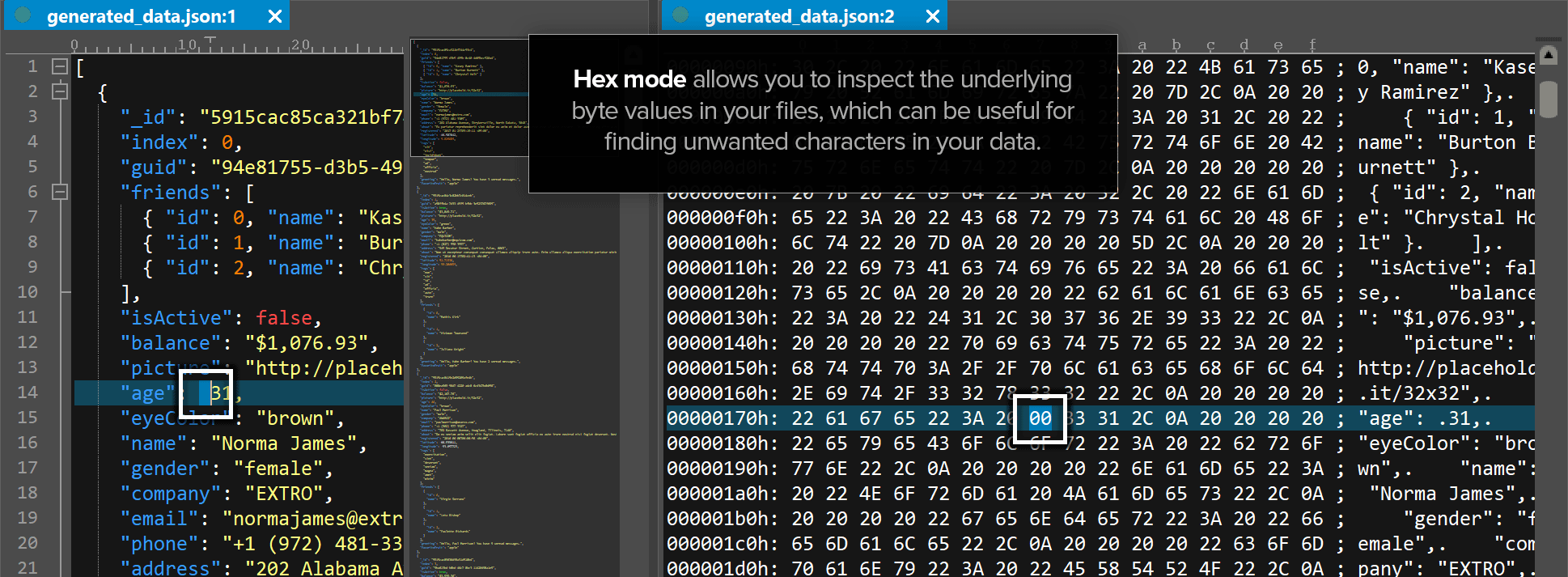
Opening a file in hex mode splits the view into three areas that update together:
- Offset (address) area — shows the byte position within the file, so you always know exactly where you are.
- Hexadecimal area — the raw byte values, typically shown as two-character hex pairs.
- Character (ASCII) area — the same bytes shown as readable characters where possible, with non-printable bytes shown as placeholders.
Editing in either the hex area or the character area updates the other automatically. Most hex editors default to overstrike mode, where typing replaces existing bytes rather than inserting new ones — insert and delete are usually separate, deliberate actions, which helps prevent accidentally shifting the rest of the file out of alignment.
To make a specific change: open the file in hex mode, use search (find/replace) or jump-to-offset to locate the bytes you need, review the value in both hex and character form before editing, then save.
Why choose UltraEdit’s hex editor over a basic hex viewer?
Most free hex viewers show you bytes and stop there. UltraEdit’s hex mode is built into a full professional editor, which means:
- One tool, not two. Switch between hex mode and standard text editing (Ctrl+H) without opening a separate application.
- EBCDIC support. View and edit EBCDIC-encoded data alongside standard hex/ASCII — useful for mainframe and legacy data files.
- Find, replace, insert, and delete for hex values, not just read-only viewing.
- Character Info dialog showing the decimal and hexadecimal value of the active byte alongside its plain-text representation.
- Configurable line width, so you can control how many hex characters display per line.
- Cross-platform. Available on Windows, macOS, and Linux.
- Commercial support if you hit an edge case working with a file you can’t afford to get wrong.
Is hex editing safe for sensitive or critical files?
Editing raw bytes is inherently precise work — a single incorrect value can make a file unreadable. The safest approach is to work from a copy, verify the offset and value in both the hex and character areas before committing a change, and use insert/delete deliberately rather than by accident. UltraEdit’s side-by-side offset/hex/character display and Character Info dialog are built to support exactly this kind of careful, byte-level verification.
Try hex editing in UltraEdit
Download UltraEdit’s 7-day free trial and see the offset, hex, and character views working together in the same editor you already use for large text and log files.

FAQ
Can a hex file be edited?
Yes. Hexadecimal is just a text representation of binary data, so any hex editor can modify the underlying bytes and save the changes back to the file.
Does Windows come with a built-in hex editor?
No. Windows doesn’t ship with a native hex editor, so you’ll need a dedicated application like UltraEdit to view or edit files at the byte level.
Is hex code still used today?
Yes. Hexadecimal remains the standard way to represent binary data for humans, and it’s still used in debugging, firmware work, low-level programming, and file format inspection.
What’s the difference between a hex viewer and a hex editor?
A hex viewer lets you look at a file’s bytes but not change them. A hex editor adds the ability to modify, insert, and delete bytes and save those changes.
Do I need to be a programmer to use a hex editor?
No, but you do need to work carefully. Understanding roughly what you’re looking for (an offset, a known byte pattern, a specific value) matters more than programming experience.
What file types can I open in a hex editor?
Any file can technically be opened in hex mode, but it’s most useful for binary files — executables, firmware images, disk images, and files that are corrupted or won’t open normally in their native application.





0 Comments